Lauren Foye, Head of Market Research & Consultancy at ZCA, spoke with William Brent, Chief Marketing Officer at Husk Power.
Husk Power: From mini-grids to an AI-enabled distributed energy platform
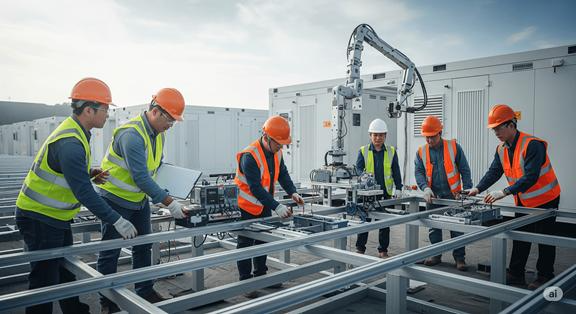
Founded in India in 2008, Husk Power began as a mini-grid company, connecting rural communities to electricity for the first time. Today, Husk[i] has evolved into what Brent describes as “an AI-led distributed energy resources platform that provides electricity to unserved and underserved customers in the Global South.” The company’s platform integrates solar and battery systems to serve three distinct customer segments:
· Community mini-grids: Husk builds generation assets plus transmission and distribution networks, enabling households and small businesses to access reliable electricity. Many of Husk’s small business customers transition from costly diesel generators to solar, saving 30–50% on monthly energy bills.
· Commercial and industrial (C&I) clients: Husk develops megawatt-scale projects for multinational companies and government institutions. Recent examples include a rice milling operation with Olam Agri in Nigeria and a state secretariat complex in Nasarawa[ii]. Husk provides its services on either an EPC (Engineering, Procurement and Construction) or PPC (Power Purchase Agreement) basis.
· Residential solar: Husk installs turnkey rooftop solar systems for homeowners while providing ongoing maintenance. India is witnessing an acceleration in adoption of rooftop solar, where nearly 2.4 million households have installed systems under the PM Surya Ghar scheme, contributing 7 GW of clean energy capacity[iii].
Source: Husk
Underlying all three of these segments is a digital infrastructure powered by predictive and agentic AI, which optimises demand forecasting, real-time management, and cost reduction. “We can deploy assets across these customer types in a capital-efficient way, reduce our costs of operation, and pass those savings on to the customer,” Brent explained.
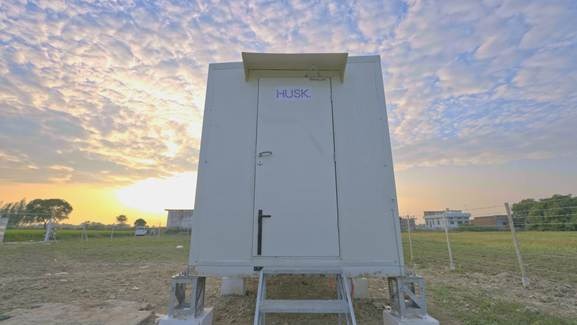
However, Husk’s innovations extend beyond AI. In 2024, the company launched PRISM, a plug-and-play “energy-in-a-box” solution that allows rapid deployment of mini-grids and C&I projects. “In India, for example, we can deploy one mini-grid per day with PRISM,” Brent noted.
Source: Husk
In addition, digital payments, EV leasing pilots, battery swapping, rice milling hubs, and cold storage projects further demonstrate Husk’s commitment to stimulating demand alongside supply. “You can’t just address the supply side… you have to look at demand as well,” added Brent.
Challenges and Opportunities
While the C&I and residential solar markets are well established globally, Brent highlighted that community mini-grids remain a nascent industry. Husk has worked for years to de-risk the model, achieving double-digit returns.
“The technology is there, the costs are there, the business models are there. Where we still have work to do is policy, regulation, and investor confidence,” Brent explained. Currency devaluation, inflation, and political instability in emerging markets add further complexity. Despite these challenges, Husk is ambitious: the company is raising $400 million in Series E funding to scale to 2 GW of assets by 2030, with an IPO targeted for 2029.
The company has established itself in both India and Nigeria, the latter being the world's largest off-grid population in the world with 80-90 million people currently lacking access to electricity. Husk is targeting Africa with further expansion and for good reason- of the 666 million people globally who remain without electricity access, 85% of them are located in Sub-Saharan Africa[iv].
The Cleantech Landscape
Reflecting on two decades in the sector, Brent noted how investor profiles have shifted. Early clean tech booms faltered when venture capital underestimated the capital intensity of asset-heavy infrastructure, compared with the asset-light software businesses many of these investors were more familiar with. Today, in what we know as ‘Cleantech 2.0’, institutional investors are more comfortable with long-term infrastructure returns, while AI is blurring the line between technology and energy companies.
“There’s this convergence of technology and energy right now… it’s very difficult to parse whether companies are technology companies or energy companies,” Brent observed. He sees emerging markets as potential leaders in redefining energy systems, integrating both utility-scale and distributed solutions.
What’s next for Husk?
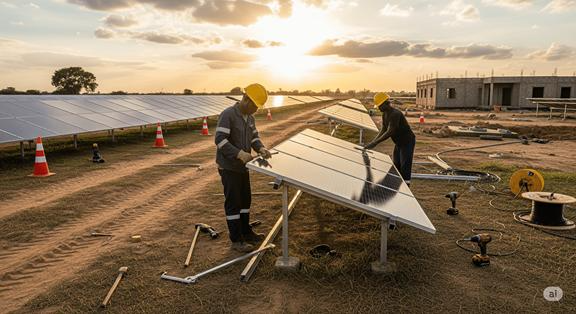
Looking ahead, Husk plans exponential growth across Africa and Asia, and with AI-driven optimisation, hardware innovations like PRISM, and a proven business model, Husk is positioned to scale rapidly.
Source: Husk
Brent explains that “there’s a huge gap today in transmission and distribution infrastructure preventing the integration of not just distributed resources, but renewable resources in general. We ask: What does the public-private partnership look like for us to be able to mobilize private capital to build systems that integrate all these different types of solutions into one and manage them in an efficient way?”. Brent says that doing so ultimately allows for better service provision to the customer and happier governments who are able to rely on private capital deployment to reduce some of their costs and turn utilities into more viable entities over the long term.
“It's going to be interesting,” he concludes. “I think emerging markets have the potential to really redefine how energy systems look in the future. We feel like we’re at the forefront of helping to push forward a new dynamic in energy systems, developed in the Global South.”
Husk Power: Cleantech for change
Husk were announced as the winners of the ZCA Cleantech for Change award for the second year running, and achieving this award was a meaningful milestone for Husk. “Our business is not easy. It requires a lot of frugal innovation… Our team of over 1,000 is one of the most dedicated and resilient out there working in the cleantech space,” Brent said.
The award recognises Husk’s ability to innovate under challenging conditions, from logistical bottlenecks, to demanding regulatory environments. “We're working in really difficult to serve communities, oftentimes in the middle of nowhere with poor infrastructure, whether it's road infrastructure, telecom infrastructure. It rewards all of the many hours of travel and deprivation required to do what we’ve done and it gives us a boost to do even better in the future,” he added.
References
[i] Husk - Distributed Energy Resources platform
[ii] Husk completes 1MW C&I solar project for Nasarawa State Government - My Framer Site