Lauren Foye, Head of Market Research & Consultancy at Zero Carbon Academy, spoke with Nikoloz Gongliashvili, BioNova Co-Founder & CEO, and Nikoloz Chikhladze, BioNova Co-Founder & CTO, on 2nd December 2025.
BioNova: A cleantech rising star
Agricultural organic waste poses a major burden on farmers, with the pressure of storage requirements, high disposal costs, and regulatory restrictions. However, it is also a significant untapped resource, where Georgian start-up BioNova aims to unlock its potential using pioneering compact, IoT-enabled biogas systems that transform organic waste into clean energy and nutrient-rich fertiliser. Named ZCA’s 2025 Cleantech Rising Star, the company operates in a region where cleantech ecosystems are still emerging, exemplifying grassroots innovation driving climate resilience from the ground up.
From waste to energy
Founded by Nikoloz Gongliashvili and Nikoloz Chikhladze in October 2024, BioNova’s[i] purpose is simple yet ambitious: “Our mission is to turn waste into energy”. The creative spark came when Gongliashvili observed methane bubbling from a lake covered in leaves, realising the untapped potential of organic waste. Within months, BioNova had built prototypes in Georgia and Pakistan, proving the viability of their design.
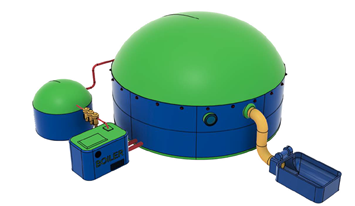
Source: BioNova
“Our digester is eco‑friendly, affordable, and designed Lego‑style so farmers can set it up in less than six hours.” — Nikoloz Gongliashvili
Their digesters offer small farms and food businesses a plug-and-play solution to reduce waste, cut energy costs, and regenerate soils. This empowers farmers and communities to convert organic waste into clean energy and natural fertiliser, driving a circular economy and offering a measurable climate impact.
“Farmers face waste overload and high energy costs. We give them biogas, electricity, and biofertiliser, all while reducing carbon dioxide emissions.” explains Nikoloz, Gongliashvili. Their USP lies in the combination of hardware and software: compact farm-ready digesters with mixing tanks, boilers, and gas storage, linked to an app that tracks energy output and fertiliser yields. It means farmers can monitor performance in real time, making the system both safe, practical, and transparent. BioNova captures methane directly at the source by placing organic waste in a hermetically sealed anaerobic reactor. The system continuously measures the concentration and flow of CH₄, and the resulting gas is sent to a CHP unit or a safe flare.
“This process avoids the uncontrolled release of methane, a greenhouse gas twenty-five times more potent than CO₂, and converts it into biogenic CO₂, which has a much lower climate impact. Based on the volumes confirmed by our sensors, the avoided emissions amount to approximately 1.1–1.2 tonnes of CO₂e per day per 100 m³ of biogas containing 60% CH₄” BioNova claim.
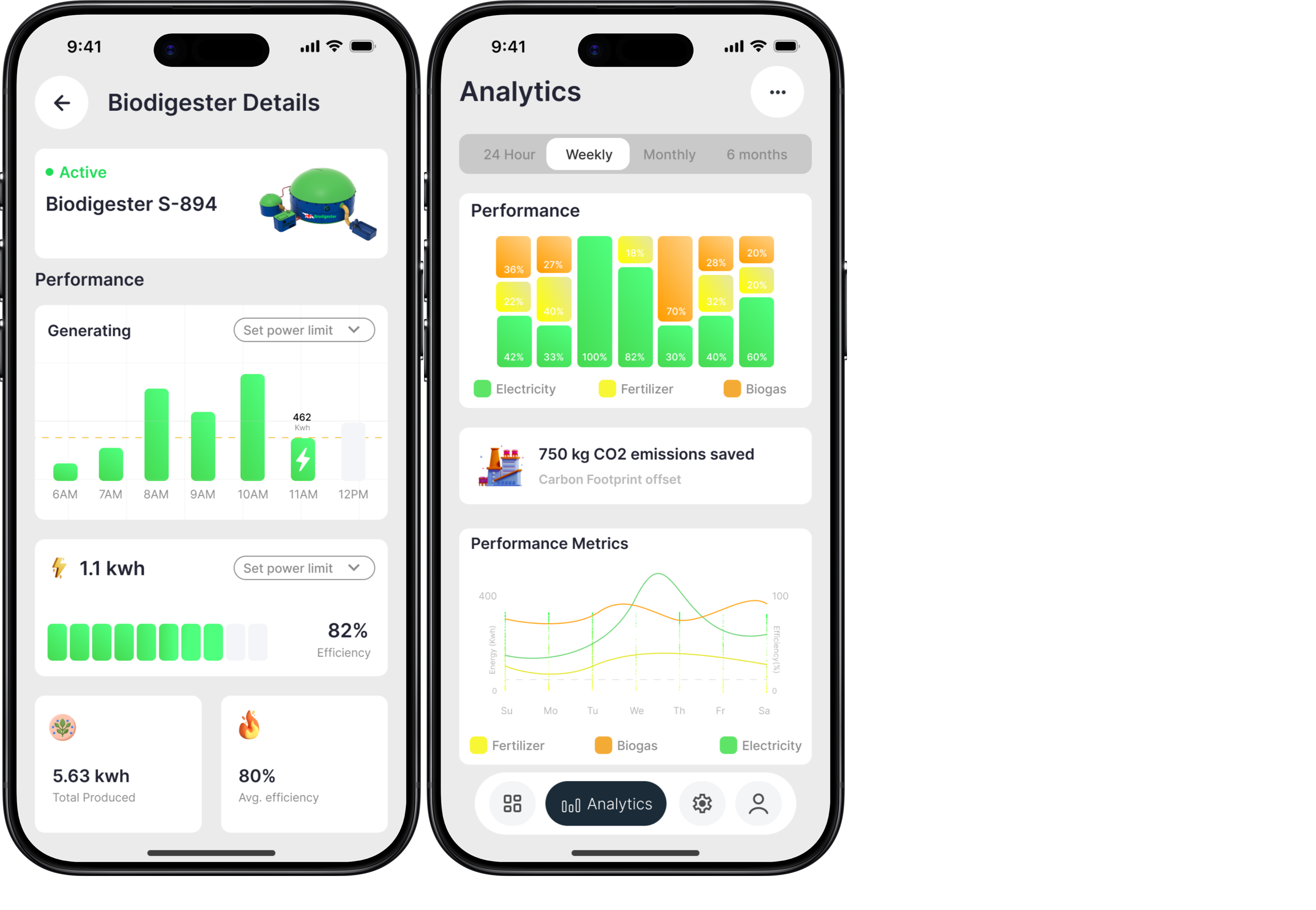
Source: BioNova
Farmer-friendly business model
Recognising that many Georgian farmers cannot afford upfront costs, BioNova have adopted a revenue-sharing model. Farmers receive devices at reduced cost, while BioNova takes a percentage of electricity or fertiliser sales, to which Nikoloz Chikhladze adds: “We’re not only making farmers profitable but also giving them the knowledge of what cleantech really means.”
In a further step, the company recently added carbon credits to their model. With the global carbon credit market estimated at $132.9 billion as of 2025 and projected to reach $576 billion by 2035[ii] this is potentially a lucrative addition. Further with 173,000 livestock farms in Georgia alone, the market potential is vast.
Georgia’s cleantech ecosystem is still in its infancy and BioNova’s journey has not been without its challenges, as Gongliashvili explained: “When we started, no one believed in biogas. People laughed. But once we got funding, they began to take us seriously.”
In fact, the startup has established a strong history of international recognition, raising over €24,100 through competitive grants and awards and participating in leading European regional and global innovation programs, including the CUnicorn pre-acceleration program as well as the ITU SEED acceleration program for international startups, and are a partner of ITU SEED as part of their portfolio startup. BioNova also participated in the Polish PARP acceleration program for Georgian startups, and the GITA Georgian Innovation and Technology Alliance grant competition, which includes a regional grant of 25,000 GEL. Additionally, the company took part in the American acceleration program GIST Innovation of South Caucasus.
In terms of partnerships, BioNova are working with DENA in the energy and biogas sector, as well as JA Europe. They are also the winners of the social impact award 2024, the winners of the Future Agro Challenge 2024, the Agropreneurs of the Year 2024, as well as the international winners of the European single market expansion award 2025.
Being a small company has had its benefits, not only from partnerships formed, such as that with DENA, but also the adaptability a smaller business possesses: “Being a startup gives us flexibility. Big companies need months to change direction — we can adapt in days.” notes Chikhladze.
In terms of the prospects for the biogas industry, at policy level momentum is building. The EU Bioeconomy Strategy (2025) recognises biogas as a cornerstone of the circular economy[iii]. Current EU biogas production generates 3 million tonnes of organic fertiliser annually, covering 17% of nitrogen demand. Meanwhile, the RePowerEU plan aims to scale biomethane production to 35 billion cubic metres per year by 2030[iv].
This shift in perception reflects a broader trend: as climate urgency grows, decentralised energy solutions like BioNova’s are gaining recognition as vital tools for rural resilience and emissions reduction.
What winning a ZCA Cleantech award means
BioNova’s journey illustrates how grassroots innovation can reshape energy access and waste management in emerging markets. By combining modular design, IoT monitoring, and creative business models, they are building resilience from the farm up. We asked Gongliashvili and Chikhladze what winning the 2025 ZCA Cleantech Rising Star award meant for their team, with Nikoloz Chikhladze saying that he believes the “Rising star fits us really nicely, and [winning the award] gives us the motivation to continue what we do- this kind of recognition fuels us.” Gongliashvili adds that when they compare themselves to their peers- companies with millions or even billions in funding, he feels that this achievement is something which is very impressive.
References
[i] BioNova - From Waste to Energy
[ii] Carbon Credit Market | Global Market Analysis Report - 2035
[iii] https://environment.ec.europa.eu/publications/bioeconomy-strategy_en
[iv] Biomethane - European Commission