Overview
In our latest report, Zero Carbon Academy (ZCA) have identified our top 5 trends for 2026 within the sustainability and cleantech space. These are trends we feel will define the coming 12 months and substantially alter the sustainability landscape.
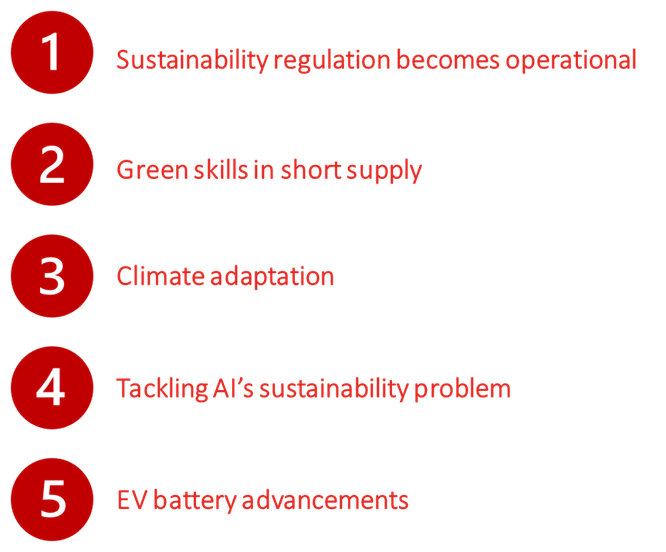
Our top 5 trends for 2026 are as follows:
Source: ZCA
1. Sustainability regulation becomes operational
Whilst last year saw companies preparing for new regulation, 2026 is the year that major pieces of legislation come online. At the forefront is the EU’s Carbon Border Adjustment Mechanism (CBAM) which will move from what was previously a reporting phase, to a financial obligation.
2. Green skills in short supply
2026 is the year organisations finally confront the skills gap standing between ambition and action. As governments tighten environmental regulations and companies accelerate their net zero strategies, demand for green skills is rising faster than supply. Today green skills are no longer confined to niche sustainability teams, instead they’re becoming a core competency across industries. From construction and finance to manufacturing, logistics, and technology, the question isn’t whether companies need green skills, but how quickly they can acquire them.
3. Climate adaptation
COP30 saw adaptation rise up the agenda as countries called for a tripling of adaptation finance by 2035, with $310 billion required annually. Given much of this will fall to the private sector, companies need act now to prioritise adaptation to safeguard resource access, protect infrastructure, and maintain competitiveness. Solutions will often be nature-based, requiring companies to build expertise in ecosystem restoration, water management, and biodiversity strategies.
4. Tackling AI’s sustainability problem
While 2025 was the year that AI entered the mainstream, with adoption soaring, 2026 is the year that businesses need to address the technologies environmental impacts. With the rapid rise of AI usage, there has been a corresponding clamour for data centre capacity to meet demand, and this comes with significant pressure on resources. Research released by the IEA last year found that growth in the use of Artificial Intelligence will lead to the global electricity demand from data centres more than doubling by the end of the decade.
5. EV battery advancements
2026 will be the year in which EV batteries experience significant change which will have major consequences for the EV industry as a whole. Major improvements to EV batteries are coming, including falling costs, new technologies, reduced charging times, and improved mileage. In the first instance, the most widely used battery technology, lithium-ion, has begun to see costs ease following years of volatility driven by supply chain shocks and mineral bottlenecks. Expectations are that prices will continue to fall during 2026. Improvements in energy density with the use of alternative chemistries such as sodium-ion and lithium iron phosphate will also aid change, but the biggest advancement this year will be in the development of all solid-state batteries (ASSBs). These are seen by some as the future of EV batteries and a strong alternative to lithium-ion. They use solid electrolytes and hold a wealth of benefits over lithium-ion.
Access the full research now to read our deep-dive analysis, and to view our heatmap and scoring methodology: Top Trends for 2026