‘Milestone moment’ reached in the EU, as renewables outpace fossil fuels
New research from think tank Ember has found that for the first time, wind and solar generated more electricity than fossil fuels in the EU. The latest European Electricity Review reports that in 2025 solar and wind combined to produce a record 30% of power, ahead of 29% from fossil fuel sources.
“This milestone moment shows just how rapidly the EU is moving towards a power system backed by wind and solar,” said report author Dr. Beatrice Petrovich. “As fossil fuel dependencies feed instability on the global stage, the stakes of transitioning to clean energy are clearer than ever.”[i]
Solar credited for renewables boom
The researchers credit solar energy as being the key driving force leading to the uptick in renewables share of electricity generation within the EU. They find that solar grew by more than a fifth (20.1%) for the fourth year running, generating a record 13% of power in the EU in 2025- ahead of both coal and hydro energy. When combined, wind and solar energy generated more electricity than all fossil fuel sources in 14 of 25 EU countries in 2025, and all EU nations saw solar generation grow in 2025, when compared with 2024.
Overall wind and solar have increased to account for 30% of EU electricity generation within the last 5 years, up from 20% in 2020. Over the same period fossil fuels have fallen from 37% of electricity generation, to just 29%, whilst hydro and nuclear have remained relatively stable.
Wind and solar overtake fossil power in the EU for the first time
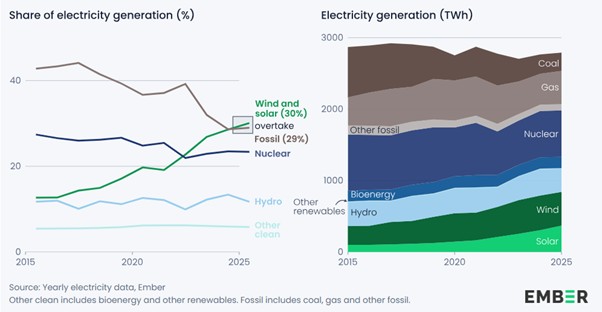
Source: Ember
Drop in hydro output fuels increase in gas use
Whilst headline figures are positive, the researchers at Ember highlight that generation from gas in fact rose last year by 8%. This was largely attributed to reduced output from hydro energy, which fell due to weather conditions (the same weather conditions which helped drive solar energy output). Ember notes that this rise in gas use pushed the EU power sector’s import bill up by 16% year on year, reaching €32 billion in 2025. Still, wind energy remained the second largest EU electricity source at 17% of EU power, generating more than gas.
This is the first increase in gas import costs for power since the 2022 energy crisis, with Italy and Germany paying the most, and will focus minds to the ongoing threat around energy security, an ongoing threat especially in the wake of Russia’s invasion of Ukraine.
European nations target offshore wind expansion with the Hamburg Declaration
In a step to bolster renewable generation and counter energy security threats, several EU members, along with other North Sea countries, recently signed a new agreement to deliver 100 GW in offshore wind energy. Agreed on Monday (26th January) at the Future of the North Seas Summit, the pact which is known as the Hamburg Declaration has been signed by the UK, Belgium, Denmark, France, Germany, Iceland, Ireland, Luxembourg, the Netherlands, and Norway. The declaration promises to enhance co-operation and accelerate efforts to turn the North Sea into the world’s largest clean energy reservoir.
The signing of the Hamburg Declaration marks a shift in how offshore wind will be deployed across Europe. The plans include new ‘offshore wind hybrid assets’, wind farms at sea that are directly connected to more than one country through interconnectors. It means that rather than a patchwork of national projects competing for seabed, grid access, and capital, the ten countries will jointly deliver 100 GW of offshore wind through cross-border projects.
The signatories have committed to delivering a more evenly distributed offshore wind tender pipeline between 2031 and 2040 across the North Sea, contributing to a European installation capacity of up to 15 GW per year, along with a pledge to de-risk offshore wind investment. In return, industry pledges cost reductions, 91,000 additional jobs and the generation of €1 trillion in economic activity.
According to data from industry body WindEurope, presently 37 GW of offshore wind capacity has been installed across 13 European countries. However, they stress that until now deployment has been dragged down by sub-optimal auction design, increased costs of capital and lack of visibility for the supply chain, due to an uncertain project pipeline[ii].
It is hoped that the new agreement will address many of these challenges. Furthermore, the Hamburg Declaration will form a crucial part of the wider North Sea ambition to reach 300 GW of offshore wind by 2050
Global renewable capacity set to double by 2030
The EU is not an outlier; more broadly renewable capacity looks set to boom across the globe through to the end of the decade. International Energy Association (IEA) research published last year forecasts that renewable energy capacity will more than double between 2024 and 2030, despite the sector facing significant headwinds across several areas including financing, policy shifts, supply chain security, and grid integration challenges.
The most recent edition of the IEA’s annual Renewables report finds that global renewable power capacity will increase by 4,600 gigawatts (GW) before 2030, with this roughly equivalent to adding the current combined power capacity of China, the EU, and Japan. This surge will be headed by solar PV, expected to account for roughly 80% of new renewables capacity globally, with the technology proving popular due to falling costs, as well as often faster planning and installation timeframes compared with other energy sources. Whilst solar will lead, it will be followed by wind, hydro, bioenergy and geothermal, with the latter forecast to hit historic highs in key markets, including the United States, Japan, and Indonesia.
References
[i] Wind and solar generated more power than fossil fuels in the EU for the first time in 2025 | Ember