


Microsoft’s renewables milestone
Microsoft has announced a ‘milestone achievement’ in its bid to become carbon negative by 2030, hitting one of its key targets. Back in 2020, the corporation announced a goal to reach 100 percent supply of renewable energy by 2025[i], last week the corporation confirmed that it had indeed matched 100 percent of its annual global electricity consumption with renewable energy for 2025.
Microsoft reports that it obtained more than 90% of renewable energy through Power Purchase Agreements (PPAs) or similar mechanisms in 2025. The remaining 10% of renewable electricity was supported via Microsoft’s standard utility relationships and rates.
PPAs have formed a key part of renewable energy expansion, where clean energy purchases have helped support reductions in transaction costs, expansion of developer access to financing, and the streamlining of procurement. Bloomberg NEF reports that collectively, more than 200 global corporations have purchased almost 200 GW of clean energy around the world since 2008.
Since announcing its goal to become carbon negative, Microsoft has contracted 40 gigawatts (GW) of new renewable energy supply across 26 countries, this is equivalent to the energy required to power 10 million US homes. Of this 40 GW total, 19 GW are already online and delivering new clean energy supply to the power grid, while the remainder are slated to come online over the next five years.
Figure one: Map showing Microsoft’s global renewable energy procurement
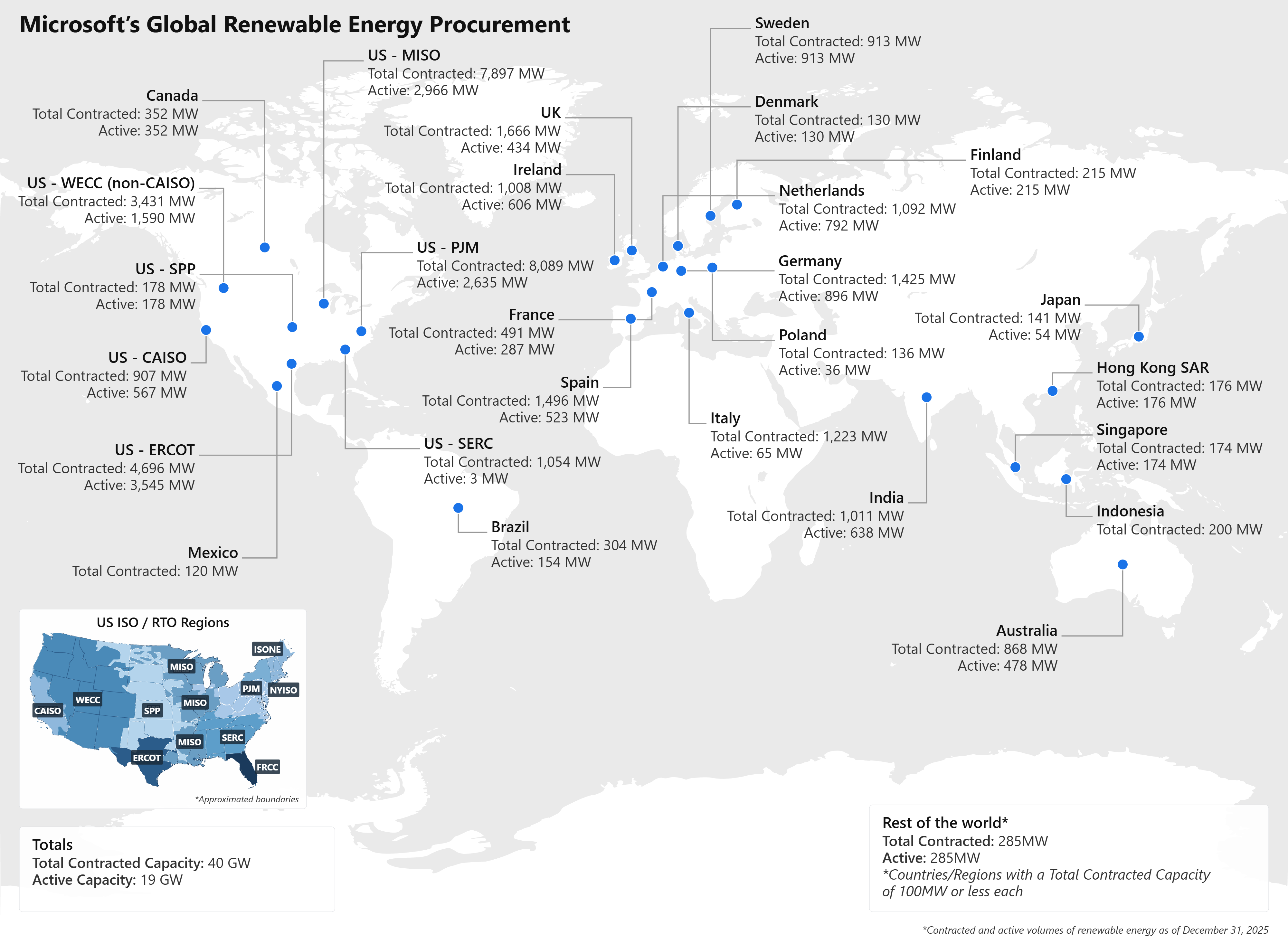
Source: Microsoft
The company highlights that its renewable energy procurement delivers significant environmental benefits, such as the reduction of its Scope 2 carbon dioxide emissions by an estimated 25 million tonnes. In addition, it has led to the mobilisation of billions of dollars’ worth of private investment in regions where the company operates.
Microsoft’s Chief Sustainability Officer, Melanie Nakagawa said in a LinkedIn post:
“In 2020, we announced our ambitious sustainability goals, which included being carbon negative by 2030. As part of this target, we committed to matching 100% of our annual global electricity consumption with renewable energy by 2025. I am proud to share that we have reached that milestone.”[ii]
She went on to note that it marks an important step on the organisation’s journey to carbon negativity, and whilst electricity remains a major source of emissions for the corporation, addressing this it is a major driver for innovation and change:
“Microsoft's experience building our clean energy portfolio has served as an important catalyst in driving commercial demand for infrastructure and innovation across the power sector. This progress reflects more than a decade of partnership and learning by doing. What began with a single clean energy contract in 2013 has grown into one of the world’s largest clean energy portfolios, supporting 40 gigawatts of contracted renewable energy across 26 countries.”[iii]
Microsoft’s AI & data centre boom
Microsoft, like many other tech giants, is having to grapple with soaring energy demands from data centres and the increasing usage of Artificial Intelligence. According to Microsoft’s 2025 Environmental Sustainability Report, new data centre builds have contributed to a 23.4 percent increase in the firm’s carbon emissions since 2020[iv]. The corporation continues to rapidly accelerate its global AI expansion and expects to invest $50 billion by 2030 to expand AI across countries in the Global South.
This has led the corporation to explore a number of alternative energy partnerships, including a deal to restart a closed reactor at the Three Mile Island nuclear plant in the United States. The nuclear facility situated in Londonderry, Pennsylvania is owned by Constellation, who announced a 20-year Power Purchase Agreement (PPA) with Microsoft. The reactor, known as TMI Unit 1, was shuttered in 2019 for ‘economic reasons’ and its restart could see not only 835 megawatts of carbon-free energy added to the grid, but also result in the creation of 3,400 direct and indirect jobs, alongside generation of an estimated $3 billion in state and federal taxes[v].
Once up and running the plant will generate enough electricity to power more than 800,000 homes annually, demonstrating the significant levels of energy needed for data centres and Microsoft’s AI ambition. It’s also not the first switch towards nuclear by Big Tech; Amazon previously purchased a data centre site next to the Susquehanna nuclear power plant in Pennsylvania and will use part of the plants energy generation to meet its electricity requirements.
References
[i] Microsoft will be carbon negative by 2030 - The Official Microsoft Blog
[ii] (3) Microsoft touts renewable energy milestone amid AI boom | LinkedIn
[iii] (3) Microsoft touts renewable energy milestone amid AI boom | LinkedIn
[iv] Microsoft emissions up 23% since 2020, company blames AI data centers - DCD
.jpg)

.jpg)
